
Flexible Coupling for Underground Mining: 7 Factors to Check Before Ordering
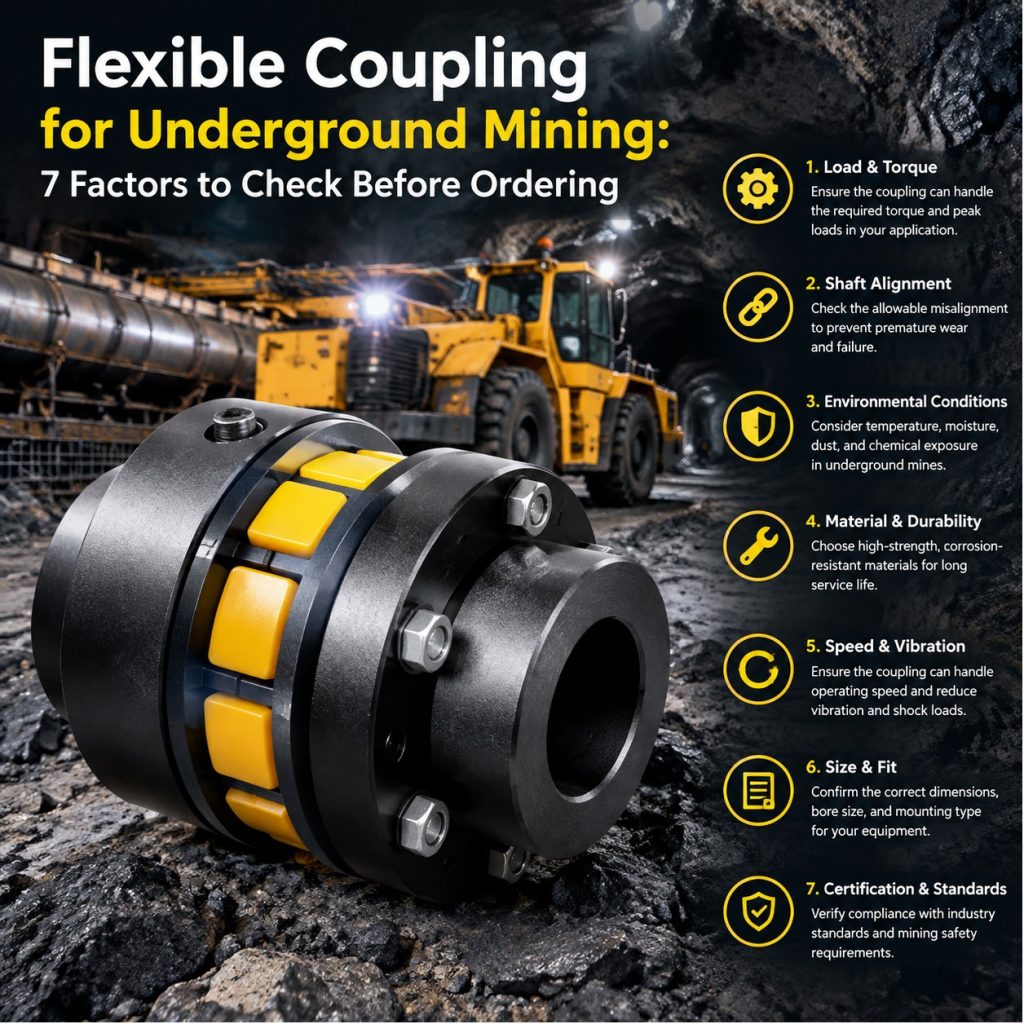 Nobody puts a flexible coupling on a purchase requisition with any enthusiasm. It sits between the gearbox and the driven shaft, it costs less than the oil in the reducer, and it gets about as much engineering attention as a grade 8 bolt. Then one lets go at the transfer point on a Saturday night shift, the main line stops, and that forgotten component is suddenly costing you more per hour than the shearer that’s sitting idle behind it.
I’ve watched this movie from both sides of the table, first as a maintenance planner underground and later quoting replacement units for a distributor. The pattern is always the same. Someone measures a shaft diameter, matches it to a catalog page, orders on price, and hopes. Six months later the element is shredded, the hubs are wallowed out, and everybody blames the coupling manufacturer.
If you’re about to order flexible couplings for a conveyor drive, a slurry pump, a crusher, a shuttle car or a ventilation fan, here are the things worth checking before the PO goes out. Not the glossy brochure items. The ones that actually decide whether the thing survives.
- Peak torque, not the number on the motor nameplate
Nameplate torque is a fantasy figure in a mine. What kills couplings is the transient: a loaded belt starting against a full head pulley, a crusher swallowing a piece of tramp steel, a pump grabbing a slug of settled solids, a brake slamming on a decline conveyor. Those events can push torque three, four, sometimes five times running load for a fraction of a second, and that fraction is enough to shear a key, strip a jaw spider or delaminate a tire element.
Ask your supplier for the peak torque rating and the allowable cyclical torque, and then apply a service factor that reflects reality rather than a spreadsheet. For a smooth-running fan, 1.5 might be generous. For a crusher or a conveyor with a brake, you want to be well above 2. And if the drive runs through a VFD with high starting torque or DC injection braking, say so up front. It changes the answer.
- What kind of misalignment you actually have, and how much
Every flexible coupling handles misalignment. The question is which type and how much, because angular, parallel and axial misalignment are three different problems and no single design is good at all of them.
Tire and sleeve couplings tolerate plenty of angular and parallel offset but almost nothing axially. Gear couplings take high torque in a small envelope but need lubrication and hate parallel offset. Jaw spiders are cheap and forgiving but limited on torque density and they fail hard when the spider goes. Disc and diaphragm packs are excellent for high speed and axial growth, useless where you need to absorb shock.
Underground, foundations move. Floor heave lifts a reducer, ribs converge, a baseplate that was grouted in March is 4 mm out by September. Measure the actual offset with a dial indicator or laser before you order, not the alignment you drew on the general arrangement. And add the thermal growth of the driven shaft to your number.
- What’s in the air and in the water
Coal dust is abrasive. Acid mine water at pH 3 will eat a standard steel hub flange and turn a cheap elastomer into chewing gum. Hydraulic oil mist, grease carryover, ozone from nearby electrical equipment and temperature swings all attack the flexible element differently.
Get specific about the elastomer. Neoprene for oil and weather resistance. Polyurethane for abrasion and higher torque density. Hytrel or a comparable polyester elastomer where you need stiffness and temperature range. EPDM where the enemy is water and steam rather than oil. And if you’re in underground coal, check that the element carries the flame-resistant acceptance your regulator requires, not a general-purpose industrial equivalent. For gassy operations outside coal, that means the appropriate hazardous-area certification on the complete assembly, not just a claim in the sales literature.
- Envelope, bore and the space to swing a wrench
A coupling that’s perfect on paper can be impossible to install in a 1.4 metre drift with the reducer bolted down and a guard frame welded in place.
Check the bore range against your actual shaft, including the keyway standard. Check hub length against the available shaft projection. Check the outside diameter against the guard and the rib clearance. If the assembly runs at speed, check balance. And find out whether the design lets you remove the element without sliding either hub, because the alternative is pulling the reducer, and that’s a shift, not a job.
- How long it takes to change out, and by whom
Downtime is the real cost of a coupling, not the invoice. A split-in-half element that two fitters can swap in forty minutes with hand tools is worth a meaningful premium over a press-fit design that needs a crane, a bearing heater and half a day.
Ask the supplier to walk you through the replacement procedure. How many fasteners? What torque? Does the element come pre-assembled? Can it be done with the guard in place? If the answer involves a hydraulic puller and a laser alignment rig, that’s fine for a surface plant, and probably wrong for a production panel.
- Spares strategy and lead times
Standardise. If your site runs six different coupling sizes across twenty drives, you will never have the right element on the shelf when you need it. Pick a family with common element sizes and common hub bores so one spare covers more than one drive.
Then ask about lead time on a replacement hub, not just the element. Elements are usually stocked. Hubs are often made to order, and a six-week lead time on a bored and keyed hub is six weeks of a drive running at reduced capacity or not at all. Keep one complete spare assembly per critical drive, and keep it where someone can find it at 2 a.m.
- Documentation, certification and the vendor’s willingness to show up
A torque curve, a material certificate for the element, a dimensional drawing, a flame-resistance or hazardous-area certificate, and a written installation and alignment procedure. If a supplier can’t produce these quickly, they’re not a partner, they’re a reseller.
The last one is harder to quantify but matters just as much. Will someone come underground and help align the first unit? Will they do a failure analysis if something goes wrong instead of quietly invoicing you for a replacement? A coupling is a small purchase with an outsized influence on your production line, and the supplier behind it should behave accordingly.
Price still matters. It just shouldn’t be the first question. Get the torque, the misalignment, the environment, the envelope, the serviceability, the spares and the paperwork right, and the price conversation becomes a lot shorter, and a lot less painful.